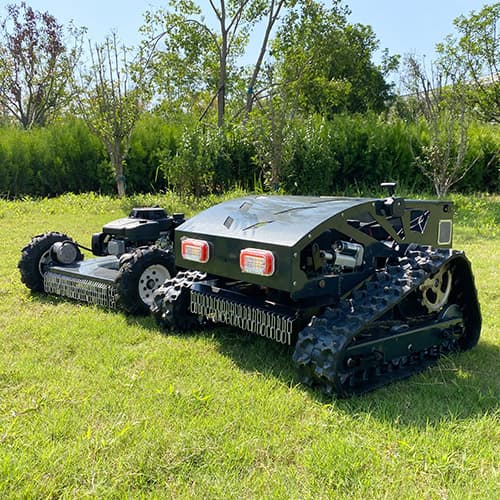

Buying a remote control lawn mower is not the same as buying a standard garden mower. From our after‑sales records, we have seen many professional buyers pick units purely based on spec sheets, only to find the machine cannot cope with their real‑world site conditions.
For a small, flat residential lawn, the decision may be relatively simple. But for professional users dealing with slopes, rough terrain, dense grass, orchards, commercial properties, or large outdoor areas, choosing the right machine requires a closer look at the actual working conditions.
The market for remote control lawn mowers is growing, and buyers now have more options than ever. Machines can differ in cutting systems, power, drive design, size, operating range, terrain capability, and intended application.
That means the “best” remote control mower is not always the biggest or most powerful one.
The right choice is the machine that matches the work you actually need to do.
This guide explains the most important factors to consider before choosing a remote controlled lawn mower for professional or commercial use.
Start With the Terrain
Before comparing engines, cutting widths, or remote control features, start with the ground.
Terrain should be one of the first factors in your decision. When customers visit our factory, our engineers always go over site terrain details before talking about horsepower or deck size.
Ask yourself:
Is the ground flat or uneven?
Are there steep slopes?
Does the terrain include soft or rough areas?
Are there ditches, embankments, or drainage channels?
Will the mower operate around trees or obstacles?
Does the ground change significantly between job sites?
A machine that performs well on a flat lawn may not be the best choice for rough commercial land.
For difficult terrain, the mower’s drive system, stability, overall design, and ability to move across uneven ground become especially important.
If most of your work involves slopes or irregular terrain, choose a machine designed specifically for demanding outdoor conditions rather than simply selecting a conventional mower with a remote control function.
Consider the Type of Vegetation
Not all grass is the same.
A well‑maintained commercial lawn creates very different mowing requirements from an overgrown field. One landscaping contractor we work with told us they underestimated how thick field brush would impact mower load on their early unit.
Before choosing a remote control lawn mower, consider what the machine will actually be cutting.
Typical vegetation may include:
Regular lawn grass
Long grass
Dense grass
Rough vegetation
Field grass
Orchard ground cover
Mixed outdoor vegetation
The type and density of vegetation can influence the cutting system you need.
A mower designed primarily for regularly maintained lawns may not be the right choice for heavy vegetation management.
For professional buyers, it is useful to think about the most demanding job the machine will regularly handle—not only the easiest one.
Choosing equipment based only on ideal conditions can lead to limitations later.
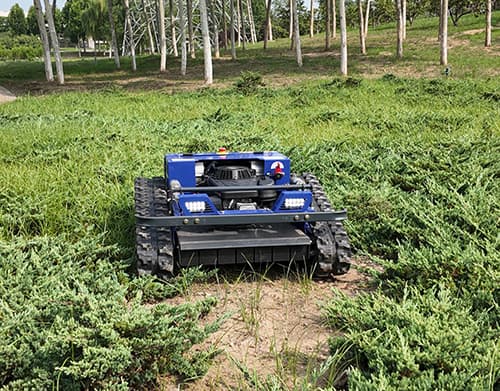
Cutting Width: Bigger Is Not Always Better
Many buyers immediately look for the widest possible cutting deck.
A wider cutting width can cover more ground in open areas, but it may not always be the most practical choice.
For example, a large mower may be highly productive on an open field but less convenient when working between trees or around obstacles.
A smaller machine may be easier to maneuver in complex areas.
The best cutting width depends on the application.
| Working Environment | Cutting Width Consideration |
|---|---|
| Large open land | Wider cutting width may improve coverage |
| Orchards | Moderate width may provide better maneuverability |
| Narrow areas | Compact dimensions can be more practical |
| Slopes | Stability and control may be more important than width |
| Mixed commercial properties | A balance between coverage and maneuverability is useful |
When comparing machines, consider how much of your work is open terrain and how much involves obstacles or restricted access.
Evaluate the Drive System
The drive system plays a major role in how a remote control lawn mower performs. During our field‑testing phase, our engineers spend long hours tuning drive response over bumpy and inclined ground.
Professional mowing often involves ground that is uneven, soft, rough, or sloped.
The machine needs to move reliably through those conditions.
Depending on the design, different remote controlled mowers may use different movement systems.
When evaluating the drive system, consider:
Terrain capability
Machine stability
Maneuverability
Ground conditions
Working environment
Ease of directional control
The right drive system should match the terrain you work on most frequently.
A mower used mainly on smooth commercial lawns may have different requirements from one used on embankments and rough fields.
Understand Your Remote Control Requirements
The remote control system is one of the most important features of the machine.
However, buyers should look beyond the fact that the mower can simply be controlled remotely.
Ask practical questions:
How intuitive are the controls?
Is the machine responsive to operator input?
Can the operator easily control direction and movement?
Is the remote comfortable to use during extended work?
Does the system provide clear operating feedback?
The purpose of remote operation is to give the operator greater flexibility.
A well‑designed control system should support that goal.
For commercial users, ease of operation can also be important when multiple employees may need to use the machine.
Think About Where the Operator Will Stand
This may sound like a simple question, but it is one of the main advantages of a remote control mower.
Traditional mowing equipment usually requires the operator to remain on or directly behind the machine.
Remote controlled equipment allows the operator to choose a different position.
When evaluating a machine, think about your typical working environment.
Will the operator need a clear view of the mower?
Are there obstacles?
Are you working on slopes?
Is the terrain difficult to walk across?
The value of a remote control lawn mower is not only in the machine itself.
It is also in the flexibility it gives the operator.
Match the Machine to Your Business
Different businesses use remote controlled mowers for different reasons.
A landscaping contractor may want one machine that can handle difficult terrain across multiple customer properties.
An orchard owner may need equipment that can move between trees.
A property maintenance company may focus on embankments and commercial land.
A vegetation management contractor may regularly deal with long and dense grass.
Before purchasing, identify your primary application.
| Type of User | Typical Requirement |
|---|---|
| Landscaping contractor | Versatility across different job sites |
| Property manager | Reliable performance for recurring maintenance |
| Orchard owner | Maneuverability around trees |
| Farm operator | Capability across uneven land |
| Vegetation contractor | Strong performance in demanding grass conditions |
| Commercial maintenance company | Efficient operation across large properties |
The right remote control mower should fit naturally into your existing workflow.
Do Not Ignore Transportation
Professional mowing equipment often needs to move between job sites.
A machine may perform extremely well in the field but create logistical problems if transportation has not been considered. Several of our European distributors shared feedback that some buyers overlook trailer dimensions before ordering.
Before buying, think about:
Machine dimensions
Overall weight
Trailer requirements
Loading and unloading
Storage space
Access to customer sites
For landscaping contractors, transportation can affect daily productivity.
A machine that is easy to move between locations can be more practical than a larger machine that requires additional preparation.
Maintenance Should Be Part of the Buying Decision
A remote control lawn mower is an investment.
Like any professional machine, it requires regular inspection and maintenance. Inside our factory, we design service points to reduce unnecessary disassembly for routine checks.
Before choosing a model, ask about:
Access to service points
Availability of replacement parts
Routine maintenance requirements
Technical support
Warranty options
Long‑term service availability
The initial purchase price is important, but it is not the only cost to consider.
Downtime can also be expensive.
For commercial users, access to parts and support may be just as important as the specifications of the machine.
Compare the Total Value, Not Just the Price
A lower purchase price does not always mean a lower operating cost.
Professional buyers should consider the complete value of the machine.
This includes:
Purchase cost
Expected working capability
Maintenance
Replacement parts
Transportation
Application versatility
Supplier support
A remote control lawn mower that is slightly more expensive but better suited to your actual work may provide better long‑term value.
The goal is not to buy the cheapest machine.
The goal is to buy equipment that can perform the required work reliably.
A Simple Decision Checklist
Before choosing a remote control lawn mower, review the following questions.
Terrain
What type of ground will the machine operate on?
Slope
Will the mower regularly work on steep or uneven areas?
Vegetation
What type of grass or vegetation will it cut?
Working Area
How large are the typical mowing projects?
Maneuverability
Does the machine need to move around trees, obstacles, or narrow spaces?
Transportation
How will the mower move between job sites?
Operation
Who will use the machine, and how easy does it need to be to operate?
Maintenance
Can you access parts and technical support when needed?
Answering these questions before comparing models can help buyers narrow their options quickly.
Common Mistakes Buyers Make
Choosing Based Only on Power
More power is not automatically the right answer. The machine must also match the terrain, vegetation, and working environment.
Buying a Machine That Is Too Large
A larger mower may cover more ground, but it can also be more difficult to transport and maneuver.
Ignoring the Terrain
Terrain should be one of the first considerations—not an afterthought.
Focusing Only on the Purchase Price
A lower initial price may not represent the best long‑term value.
Forgetting About After‑Sales Support
Professional equipment needs maintenance. Reliable parts and technical support should be part of the buying decision.
Choosing a KOIVI Remote Control Lawn Mower
KOIVI develops remote control lawn mowers for professional applications involving challenging terrain and demanding vegetation.
When selecting a KOIVI mower, the best starting point is to explain your working conditions.
Information such as terrain type, slope conditions, vegetation, working area, and intended application can help identify the most suitable machine.
Professional buyers may have very different requirements.
A landscaping contractor working across multiple commercial properties may need versatility.
An agricultural customer may prioritize terrain capability.
A vegetation management contractor may focus on cutting performance.
The right configuration depends on the job.
That is why choosing a remote control lawn mower should begin with the application rather than simply selecting the largest available model. If you would like to talk through your site details with our engineering team, you can get connected via WhatsApp.
Frequently Asked Questions
What should I consider before buying a remote control lawn mower?
The most important factors include terrain, slope conditions, vegetation type, cutting width, drive system, maneuverability, transportation, maintenance, and supplier support.
Is a remote control lawn mower suitable for slopes?
Remote control lawn mowers are often used for challenging terrain, including slopes and embankments. Buyers should always choose a model designed for their specific working conditions and follow the manufacturer’s operating guidance.
What cutting width should I choose?
The best cutting width depends on the working environment. Large open areas may benefit from wider coverage, while orchards, narrow areas, and obstacle‑filled sites may require greater maneuverability.
Can one remote control mower handle different job sites?
Many professional users choose remote controlled mowing equipment because of its versatility. However, the machine should still be matched to the types of terrain and vegetation it will encounter most often.
Why is after‑sales support important?
Professional equipment requires maintenance and replacement parts over time. Reliable technical support and parts availability can help reduce downtime and protect the long‑term value of the machine.
The Right Mower Is the One That Fits the Job
Choosing a remote control lawn mower should not begin with a product brochure.
It should begin with the work.
Look at the slopes you need to mow.
Look at the vegetation.
Look at the size of your projects.
Look at how the machine will be transported.
And consider what type of jobs you expect to take on in the future.
A remote control lawn mower can become a valuable part of a professional equipment fleet when it is selected for the right application.
For KOIVI, the goal is not simply to offer another type of lawn mower.
It is to provide practical equipment for professional users working in environments where conventional mowing solutions are not always enough.
Choose the terrain first. Understand the job second. Then choose the remote control lawn mower that is built to handle both.