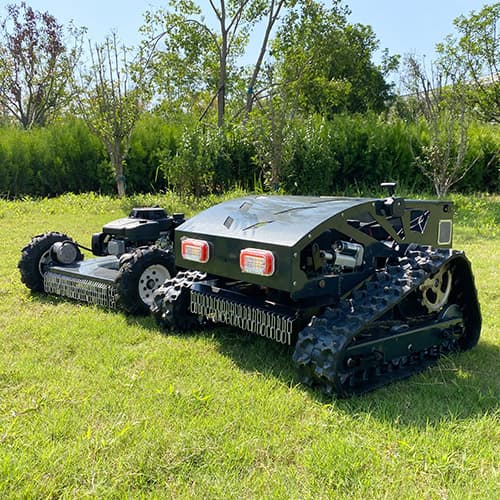

Start with the Ground, Not the Machine
A remote control lawn mower may deliver excellent results on flat lawns, yet tough‑terrain applications bring entirely new sets of operational challenges. Uneven ground, damp grass, variable inclines, thick vegetation and confined working zones all influence machine mobility, cutting output and response to operator inputs. For professional landscaping contractors, agricultural operators and vegetation‑management crews, these real‑world factors outweigh marketing‑focused headline specs. Equipment has to perform reliably under actual jobsite circumstances, not merely in ideal lab‑test environments.
That makes traction, stability and cutting performance core evaluation criteria for professional‑grade remote‑control mowing hardware. KOIVI develops tracked remote control mower solutions built for high‑demand land‑maintenance assignments. Learning how these key performance metrics get assessed empowers buyers to make better purchasing decisions for slopes, rough grass, roadside embankments and other difficult sites. While exact testing workflows differ across models, terrain profiles and manufacturers, systematic assessment must observe machine behaviour as working conditions shift. Compact units including the mini tank mower also go through comparable multi‑condition validation for constrained‑space tough‑terrain deployments.
Prior to running any mower evaluation, it is critical to map out the terrain the unit will service. Different surface types place distinct stress on drive assemblies, chassis frames and cutting decks. A firm dry slope delivers vastly different grip compared with wet grass or loose topsoil, even when gradient values are identical.
A practical pre‑test terrain assessment covers these common surface scenarios:
Firm, relatively level ground
Uneven grass with minor elevation shifts
Sloping grass‑covered surfaces
Long or dense overgrown vegetation
Mixed‑condition ground surfaces
Obstacle‑filled or restricted‑access zones
Assessment is not only about locating the steepest slope available. It analyses interactions between terrain, plant growth and ground surface states. For instance, a mower travelling smoothly over firm grass can suffer reduced traction once the ground turns damp. Thick vegetation also adds load to the cutting mechanism, changing performance during extended continuous operation. Professional purchasers should always benchmark machines against their intended operating scenarios, and all testing activities must stay within manufacturer‑published operating boundaries.
Three Performance Factors That Need to Work Together
Traction, stability and cutting performance are frequently discussed separately, but they are tightly interconnected in real‑world mowing jobs.
Traction: Maintaining controlled movement
Traction defines how well the mower transfers driving force onto ground surfaces. Insufficient grip causes track or wheel slip, lowers maneuverability and results in unpredictable machine movement.Stability: Remaining within operating limits
Stability refers to the machine’s capacity to hold a controlled position and resist tipping or unintended displacement. Chassis layout, centre‑of‑gravity placement, terrain profile and travel direction all exert influence.Cutting performance: Delivering a consistent result
Cutting output is determined by cutting‑deck configuration, available power, blade condition, vegetation density, cutting‑height adjustment and forward travel speed.
A mower delivering clean cuts on flat ground will not guarantee equal quality on inclines. Similarly, great traction means little without a cutting system matched to local vegetation. Evaluating these three attributes in combination creates a realistic picture of whether a remote‑control mower fits professional‑grade field‑work. Many mixed‑terrain contracting teams also look into robot crawler lawn mower models that balance all three performance pillars.
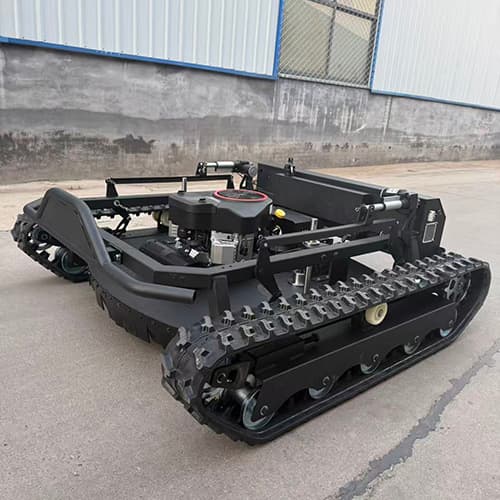
Inside a Practical Traction Evaluation
Traction testing observes how the mower travels across approved surfaces and reacts to shifting terrain conditions. For tracked equipment, track profile, ground contact footprint, drive‑system tuning and weight distribution shape performance. Wheeled units have separate considerations including tire construction, contact pressure and ground‑surface quality.
A structured traction assessment covers these key points:
Forward and reverse movement
Operate the mower on designated test surfaces to verify predictable bidirectional travel. Smooth, consistent response supports precise manoeuvring around field‑site obstacles.Turning behavior
Turning puts different mechanical stress on drive components compared to straight‑line travel. Assessment checks for predictable rotation without excessive surface scuffing or unexpected machine drift.Response to uneven ground
Minor elevation changes alter ground contact points and machine motion. Testing validates controlled progress within official operating parameters.Surface‑dependent traction
Dry turf, damp plant cover and loose soil deliver varying grip levels. All performance observations need to be logged alongside corresponding surface conditions.Control consistency
Operators should achieve predictable adjustments via the remote‑controller. Erratic or inconsistent responses make fine‑tuned manoeuvres difficult.
Valid traction assessment cannot rely on a single successful test run. Repeated observations under well‑documented conditions deliver reliable comparison benchmarks. Buyers also must draw a clear distinction between raw traction performance and slope capability: strong grip alone does not prove safe operation at a specific gradient.
Stability Testing: Why Slope Angle Is Only Part of the Picture
When shopping for a remote control slope mower, advertised maximum slope ratings grab most customers’ attention. Even so, this single figure cannot fully describe machine behaviour under diverse real‑world terrain. Stability stems from multiple interacting variables: centre‑of‑gravity layout, track or wheel geometry, chassis design, weight distribution, surface grip and travel direction. Ground topography also plays a major role; a uniform smooth incline behaves very differently from ground featuring ruts, depressions, sharp elevation shifts or hidden obstructions. Comprehensive professional stability evaluation therefore extends well beyond simple gradient numbers.
Longitudinal and Cross‑Slope Conditions
Longitudinal slope travel means moving uphill or downhill. Cross‑slope operation describes travelling sideways across the face of an incline. These two modes impose distinct mechanical demands on equipment. Manufacturer documentation should define permitted travel directions and valid operating scenarios. All testing must stay within published limits and adopt proper risk‑control protocols. Buyers must never attempt to discover absolute maximum slope performance by pushing hardware past official specifications.
Changes in Surface Conditions
A slope easily managed on firm dry grass can become highly challenging once surfaces turn wet. Surface irregularities modify ground contact points and degrade overall stability. For that reason, test documentation must capture surface type, moisture status, gradient, vegetation profile and machine configuration settings.
Operator Visibility and Control
Remote‑control working modes let operators stand apart from equipment, yet clear visibility remains non‑negotiable. Operators require unobstructed sightlines to monitor the mower plus surrounding hazards so they can adjust movement and react to changing jobsite conditions. Obstacles, dense plant growth, operating distance and site layout all impact visual awareness. Remote operation is no replacement for formal operator training, thorough site assessment and strict compliance with manufacturer operating manuals.
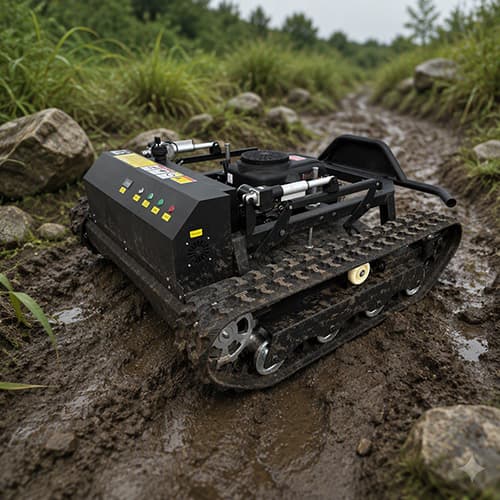
Cutting Performance Under Realistic Workloads
Pure spec‑sheet data offers limited insight into true cutting performance. A unit can boast a certain cutting width and power rating, but actual field results are shaped by grass height, stem thickness, moisture levels, vegetation density, blade health, cutting‑height setting and forward travel speed.
A thorough cutting‑performance assessment answers these core questions:
Does the mower produce acceptable cutting quality under target working scenarios?
Can it process target vegetation without frequent deck clogging?
Does cutting quality hold steady across multiple consecutive passes?
Can operators keep precise machine control when vegetation density fluctuates?
Are cutting‑height settings and travel speeds suitable for assigned work?
Can routine cleaning and blade inspections be completed efficiently?
For rough‑grass and heavy vegetation management, picture‑perfect manicured lawn finish is not always the primary goal. Consistently effective vegetation removal takes higher priority. For well‑kept commercial estates, uniform cutting appearance becomes far more critical. This key distinction guides equipment selection because different mowing assignments demand different performance benchmarks.
How Different Test Conditions Affect Results
The table below demonstrates why terrain and workload parameters should always be logged during mower assessment. These represent general engineering evaluation principles and are not official KOIVI internal test‑result data.
| Test Condition | Performance Factor to Observe | Practical Significance |
|---|---|---|
| Firm, dry grass | Drive response and maneuverability | Provides a baseline for normal movement |
| Damp grass | Changes in grip and control | Helps identify surface‑dependent traction limitations |
| Uneven ground | Ground contact and directional control | Shows how the machine responds to surface irregularities |
| Long, dense grass | Cutting consistency and machine load | Helps assess suitability for heavier vegetation |
| Sloping ground within approved limits | Stability and controlled movement | Supports application‑specific equipment evaluation |
| Repeated mowing passes | Consistency and operational behavior | Helps reveal issues that may not appear in a single pass |
All test outcomes must be interpreted within context. Solid performance under one set of conditions does not guarantee identical results in alternate scenarios. For commercial buyers, documented real‑world performance matching their own jobsites carries far more weight than generic marketing claims about difficult‑terrain capability. You can explore our full RC mower lineup when comparing models built for challenging working environments.
From Testing to Product Improvement
Testing delivers maximum value when field observations feed directly into engineering refinement. If traction proves inconsistent on certain surfaces, development teams will revisit drive‑system layout, ground‑contact geometry, machine configuration or official operating guidance. Where cutting quality degrades in thick vegetation, engineers examine cutting‑deck design, blade specifications, travel‑speed parameters and power‑demand profiles. Should operators report awkward handling inside confined zones, controller UI and manoeuvring characteristics get further optimisation.
This represents an iterative development workflow rather than simple pass‑fail testing. A typical product‑development cycle follows these steps:
Defining target applications and required performance benchmarks
Selecting representative terrain and vegetation test scenarios
Running controlled evaluations inside approved safety boundaries
Logging performance observations plus any operational defects
Comparing collected data against original project requirements
Implementing design revisions or updated operator guidance
Re‑running relevant evaluations post‑modification
Exact workflows change per machine model and development phase, varying between manufacturers. For KOIVI, the core goal of professional‑grade mower development is aligning machine hardware and official operating recommendations with real‑world application demands. Any specific statements regarding internal test workflows, measured performance figures or validation criteria need cross‑checking against corresponding model documentation.
Why Testing Matters to Professional Buyers
For landscaping contractors, roadside‑maintenance crews, agricultural operators and property managers, evaluation testing is not purely an engineering‑department concern. It has direct real‑world impacts on purchasing decisions. A machine well‑suited for one assignment can perform poorly for different site conditions. As an example: a contractor servicing wide‑open embankments may prioritise slope rating and cutting coverage; grounds‑maintenance teams working around tree clusters and narrow gateways focus heavily on manoeuvrability.
Before purchase, buyers should seek documentation answering these practical questions:
What terrain categories is this model engineered to handle?
What are its approved slope limits and operational restrictions?
Which vegetation types is its cutting‑deck designed to process?
How does the manufacturer describe its traction‑system properties?
What safety features are integrated onboard?
What maintenance tasks are required after work in wet or dusty environments?
Are application‑specific machine demonstrations or assessments available?
What technical documentation and post‑sales support can customers receive?
Whenever feasible, buyers should inspect equipment under conditions mirroring their actual jobsites while strictly following safety guidance. Live hands‑on demos uncover details impossible to extract from brochures: controller ergonomics, site‑access constraints, machine physical dimensions and day‑to‑day service requirements.
The KOIVI Approach to Challenging Terrain
Professional remote‑control mowing equipment needs to be assessed as a complete integrated system. Traction, stability, cutting output, controller responsiveness, serviceability and operator sight‑lines all collectively define suitability for each unique job‑site. KOIVI builds remote‑control mowing solutions for professional land‑maintenance projects where harsh terrain and demanding operating conditions shape equipment‑selection criteria.
Prospective KOIVI customers should start procurement by clearly defining target use‑cases. A roadside‑maintenance contractor requires hardware for grass‑covered embankments; farm operators need vegetation management for uneven agricultural ground; landscaping firms seek machinery that complements their existing fleet for hard‑to‑reach zones. Every application carries its own set of priorities.
Instead of fixating on isolated single‑line specifications, purchasers ought to review full model documentation: operating boundaries, cutting‑system parameters, control‑set functions, maintenance workflows and available vendor support. This application‑first mindset ensures equipment buying decisions match real‑world work demands. Should you wish to go over your jobsite parameters and model‑selection requirements with KOIVI product specialists, you can get connected via WhatsApp.
Frequently Asked Questions
1. How do manufacturers evaluate remote control mower traction?
A structured evaluation may examine forward and reverse movement, turning behavior, control response, and performance on representative surfaces. Conditions should be documented because traction can vary with moisture, ground material, slope, and vegetation.
2. Why is stability important for remote control lawn mowers?
Stability affects how a mower maintains controlled movement on uneven or sloping terrain. Machine design, weight distribution, surface grip, travel direction, and operating conditions all contribute to stability.
3. Does a higher maximum slope rating always mean a better mower?
No. Maximum slope capability is only one specification. Buyers should also consider the approved direction of travel, ground conditions, traction, machine configuration, and the intended application.
4. How can cutting performance be tested?
Cutting performance can be assessed by observing the quality and consistency of the cut, suitability for different vegetation types, response to changing grass density, and behavior over repeated passes under documented conditions.
5. Can wet grass affect remote control mower performance?
Yes. Wet grass can reduce traction and may change cutting conditions. Operators should follow the manufacturer's guidance on surface conditions and avoid operating where grip, stability, or visibility is inadequate.
6. What should buyers request before purchasing a KOIVI remote control mower?
Buyers should request the relevant model's specifications, operating limits, cutting capabilities, maintenance guidance, warranty information, and technical support details. A demonstration may also help determine whether the machine fits the intended application.
7. Can remote control mowers replace conventional mowing equipment?
Not in every situation. Remote control mowers can complement walk‑behind mowers, ride‑on machines, tractors, and other specialized equipment. The best combination depends on the terrain, vegetation, accessibility, and workload.
Reliable Performance Starts with the Right Evaluation
Challenging‑terrain mowing places far higher mechanical demands on equipment compared with regular lawn upkeep. Qualified machinery must combine controlled mobility, solid stability, dependable cutting results plus operator‑friendly control interfaces matching end‑user requirements. Professional purchasers need to assess these performance metrics together and always reference real‑world jobsite environments.
Traction assessments analyse mobility across varied ground surfaces. Stability evaluations establish safe working boundaries. Cutting‑performance checks validate the machine’s capacity to process target vegetation. Combined, these assessments deliver robust reference points for selecting remote‑control mowing hardware.
KOIVI remote control lawn mowers represent an option for professionals sourcing specialised equipment for demanding mowing scenarios. Cross‑reference model specs and official operating guidance against your own site requirements to make well‑informed procurement decisions.
On challenging terrain, dependable mowing begins with understanding the ground, evaluating the machine, and choosing equipment that matches the job.